Fresno County Public Records refer to documents created, filed, or stored by county agencies during official activities. These records play a central role in government transparency, public awareness, and legal accountability. They exist in both paper and digital formats, depending on the department and record type. In Fresno County, several offices manage these materials, including the Superior Court, County Clerk, Recorder’s Office, and Assessor. Each agency maintains specific categories of public documents based on its duties. For instance, the Recorder preserves property and land records, whereas the court maintains case files and docket information. State laws define which government records remain open for public review and which stay restricted. This framework protects privacy while supporting public rights. Residents, businesses, and researchers rely on official records to confirm facts, validate transactions, and review historical data. Accurate recordkeeping strengthens trust in local institutions and helps maintain consistent public services across Fresno County jurisdiction.
A structured search of Fresno County Public Records can reveal valuable details across many record categories. Users often locate court filings, property documents, business registrations, or vital record indexes. For example, a person may check a civil case status or confirm ownership history for real estate. Digital databases now simplify searches through name filters, case numbers, and date ranges. Online systems improve efficiency and reduce the need for in-person visits. At the same time, each department applies verification and data review steps before releasing information. This process supports reliability and record integrity. Some documents remain confidential due to legal protections, sealed cases, or sensitive personal data. Clear jurisdictional control ensures that records originate from authorized Fresno County sources. Responsible use remains essential. Users should verify identifiers, review record dates, and respect disclosure limits. Careful evaluation of public documents leads to better decisions, stronger compliance, and more confident research outcomes.
What Are Fresno County Public Records?
Fresno County Public Records are documents created, received, or stored by county agencies during official work. These government records remain open for public review unless state or local laws restrict disclosure. Public records represent information tied to government operations and decisions. They may exist as paper files, scanned images, or digital entries. Fresno County Court manage these materials under California public record laws. Each agency applies classification and retention schedules to organize county records. Many records stay available through searchable databases or request procedures. This system supports transparency while protecting legally confidential data.
Legal Definition of Public Records
Under the California Public Records Act (CPRA), a public record includes any recorded information tied to government activity. The format does not matter. A record may exist as a document, email, database entry, map, or image. Each Fresno County department manages records based on its duties. The Superior Court oversees judicial case data. The Recorder’s Office maintains land and property records. The Clerk’s Office handles vital and business registrations.
Examples of qualifying records:
- Legal filings: civil records, criminal case entries, probate matters
- Recorded documents: deeds, liens, easements, parcel updates
- Administrative records: policies, meeting minutes, budgets
- Civil records: permits, licenses, code enforcement files
Why These Records Are Public
Public availability promotes open government and civic trust. Residents can review how agencies act and make decisions. Journalists and researchers rely on government records for fact-checking. Public visibility discourages misuse of authority. It also strengthens accountability at the county level. At the same time, privacy laws protect sealed or sensitive civil records. Open records help people confirm facts before making legal or financial choices. They support fair reporting, academic study, and community oversight. Businesses may verify licenses or compliance history through recorded documents. Legal professionals often review filings to prepare for hearings or case updates. Clear disclosure rules balance transparency with confidentiality requirements. This balance protects personal data while preserving the public’s right to review eligible county records.
Transparency and Public Rights
Access to Fresno County Public Records protects the public’s right to information. People use these records to confirm legal status, research property history, or review administrative decisions. Clear procedures help users locate data through indexes, case numbers, or names. By maintaining accurate county records, Fresno County agencies promote fairness, clarity, and informed decision-making.
Responsible use matters:
- Verify names, dates, and identifiers
- Check record status, such as active or archived
- Respect legal limits and privacy protections
How to Search Public Records
Users locate hearing details by selecting Case Information → Case Access → Hearing Search. The Case Access page provides options such as Smart Search for Record Search, and Hearing Search. Following the proper navigation path inside the Fresno County Superior Court system improves search accuracy. Each tool serves a specific purpose, so selecting the right one matters.
Visit the Official Court Website
Open the Fresno County Superior Court portal:https://www.fresno.courts.ca.gov
- Locate the main menu
- Click Case Information
- This section contains public case lookup services.
Open Case Access
Inside Case Information:
- Click Case Access
The system displays two main searching ways:
- Smart Search Record Search
- Hearing Search search for hearing for a specified date
Smart Search
Smart Search provides a flexible lookup experience.
Users may search using:
- Party name
- Case number
- Business name
- Combines multiple search methods
- Helpful when limited details are known
- Broad result coverage
Record Search
Record Search focuses on locating specific case files.
Users can retrieve:
- Case summaries
- Legal filings
- Civil and administrative records
- Best for detailed record review
- Suitable for legal research
- Requires accurate identifiers
Using the Hearing Search
Hearing Search displays scheduled court hearings.
- Used to find hearing dates
- Shows courtroom or department details
- Useful for attorneys and involved parties
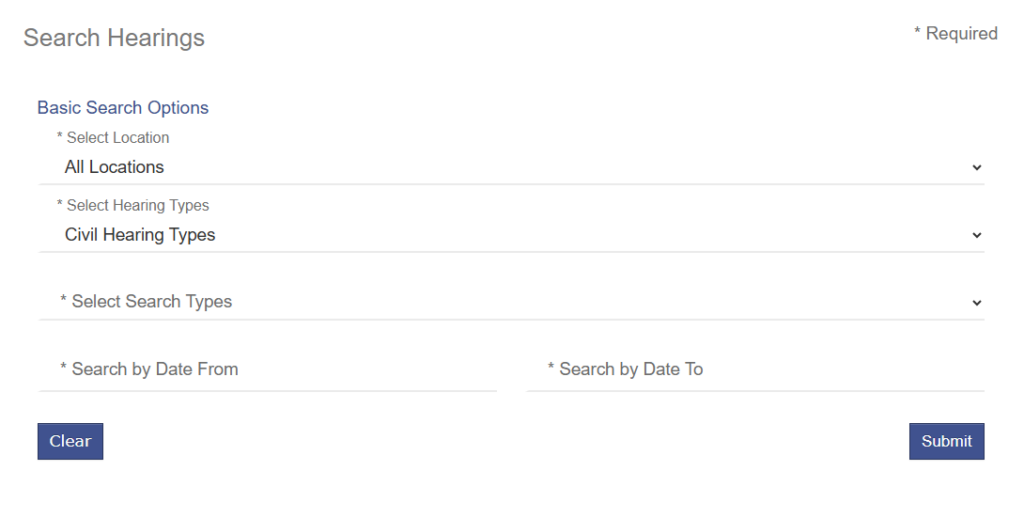
Selecting this option opens the Search Hearings interface.
Select Location
- Click Select Location
- Choose All Locations or a courthouse
This filter limits where hearings appear.
Select Hearing Types
- Click Select Hearing Types
- Choose Civil Hearing Types or another category
Options vary based on case type.
Select Search Type
- Open Select Search Types
- Choose the desired filtering method
Enter Date Range
Use correct date format. Avoid wide ranges for faster results. It Provide:
- Search by Date From
- Search by Date To
Submit Search
- Click Submit
- Review matching hearing listings
Results often include:
- Case number
- Hearing date
- Court department
Types of Public Records Available in Fresno County
Fresno County Public Records include court, criminal, property, and administrative documents maintained by official agencies. These records may also contain information reflected in a court docket, depending on record type, legal status, and disclosure rules. Public records cover a wide range of information created during government operations. These county records help residents verify facts, review legal matters, and research property or business data. Each Fresno County department manages specific record categories. Some files appear instantly through online systems, while others require a formal request. Availability varies based on confidentiality laws and record retention schedules.
Court Records
Fresno County court records contain case details, filings, and hearing information handled by the Superior Court. A Fresno court case lookup allows users to search civil, probate, family, and small claims matters. Court records represent one of the most frequently searched public record categories. These files document legal proceedings, judicial actions, and case outcomes. They may include party names, case numbers, docket entries, and scheduled hearings. Courts organize records by division and case type. Record availability depends on case status and legal restrictions. Active cases often display updated docket entries. Archived files may require additional retrieval steps. Confidential or sealed matters remain unavailable for public viewing.
Common Fresno County court record types:
- Civil cases – disputes, contracts, personal injury
- Probate – estates, guardianships, wills
- Family court – divorce, custody, support
- Small claims – limited-value disputes
- Hearings & filings – motions, orders, case events
Criminal Records
Fresno criminal records contain information about arrests, charges, and court outcomes. An arrest records Fresno search may reveal booking and custody details. Criminal records help confirm legal history within Fresno County jurisdiction. These government records often include charges filed, case progress, and final judgments. Public visibility depends on disclosure laws and privacy protections. Some records remain restricted or sealed by court order.
Information commonly found:
- Charges and case classification
- Convictions and sentencing outcomes
- Warrants where disclosure is permitted
- Booking records and custody updates
- Inmate search results
Vital Records
Vital records document major life events recorded by Fresno County authorities. Common searches include birth records Fresno County and death certificates Fresno. These official records support identity verification, legal claims, and family research. Certified copies may be required for passports, benefits, or legal filings. Access rules vary based on eligibility and relationship. Requests often require identification and applicable fees.
Vital record categories:
- Birth records
- Death certificates
- Marriage records
- Divorce records
Property & Land Records
Fresno County property records track ownership, transfers, and legal claims tied to land. A search may reveal recorded deeds and parcel details. The Recorder’s Office and Assessor manage most property-related county records. These files help verify title history, valuation, and encumbrances. Parcel numbers often deliver the most accurate results.
Records typically available:
- Ownership records
- Recorded deeds
- Parcel search results
- Assessor data
- Liens and legal notices
Business & Licensing Records
Fresno County business records include registrations, permits, and trade name filings. Users often search DBA filings for fictitious business names. These administrative records help verify a company’s legal standing. Entrepreneurs, lenders, and compliance teams rely on this data. Availability depends on filing status and agency policies.
Business record examples:
- Fictitious business names
- Permits and licenses
- Registrations
- Status updates
What Information Court Records May Show
Court databases typically present structured summaries. Details vary by case type and court division. Some documents may require a copy request.
| Record Element | Description |
|---|---|
| Case Number | Unique identifier for tracking |
| Party Names | Individuals or entities involved |
| Filings | Motions, pleadings, court documents |
| Hearings | Scheduled dates and departments |
| Case Status | Open, closed, pending |
Why Users Search Court Records
Residents and professionals rely on court records for many reasons. Legal research, background review, and case monitoring remain common purposes. Attorneys often track filings and hearing schedules. Property buyers may verify litigation tied to real estate. Employers may review civil judgments where permitted by law. Accurate searches require correct names or case numbers. Filters such as filing date or division improve result precision.
Fresno County Court Records Lookup
A Fresno County court records lookup helps users locate case details, filings, and hearing schedules. Many searches can be completed online, while certain records require an in-person visit. Court records remain a core part of any Fresno public records search. These files document proceedings handled by the Fresno County Superior Court. Residents, attorneys, and businesses review them to verify legal status. Accurate lookup methods reduce delays and incomplete results. Knowing what information appears in these records improves search efficiency. Proper use of filters and identifiers leads to clearer outcomes.
What Information Is Included in Court Records
Court records contain data created during legal proceedings. The content varies by case type and court division. Many systems display summaries before full documents. Users often see structured entries rather than scanned images. Details update as filings and hearings occur. Some information may remain restricted by law. Certain documents require copy requests or processing fees.
Typical record elements include:
- Case number search data
- Party name lookup results
- Docket information
- Scheduled hearing dates
- Filed filings and motions
- Case status updates
Civil vs Criminal vs Family Court Records
Fresno County courts organize records by legal category. Each division handles specific types of cases. Choosing the correct category improves lookup accuracy. Records differ in structure and disclosure limits. Some divisions publish more details than others. Privacy rules affect sensitive matters.
- Civil Court Records Civil cases involve disputes between individuals or organizations. These records may show complaints, responses, rulings, and judgments. Property conflicts and contract issues fall into this group. Civil filings often appear in online databases.
- Criminal Court Records Criminal matters involve charges filed by the state. Records may include charges, court appearances, plea entries, and sentencing. Visibility depends on disclosure laws and case status.
- Family Court Records Family cases address personal legal matters. These include divorce, custody, and support proceedings. Certain family records may have restricted public visibility.
Online vs In-Person Court Record Searches
Users may search records through online systems or courthouse visits. Each method offers different advantages. Online lookup tools provide convenience and speed. In-person searches help with archived or complex files. Availability depends on digitization and retention policies. Some requests require identity verification. Fees may apply for copies or certifications.
Online Search Benefits
- Quick retrieval
- Remote convenience
- Filters for names and numbers
- Immediate docket review
In-Person Search Benefits
- Useful for archived records
- Clerk assistance available
- Access to public terminals
- Suitable for detailed retrieval
Fresno Criminal Records Search
A Fresno criminal records search helps users review publicly available information related to arrests and court proceedings. Results may include Fresno County arrest records, charges, and custody details where disclosure rules allow release. Criminal records searches serve many practical purposes. Employers may review them during background checks permitted by law. Attorneys often examine them for case preparation and verification. Residents sometimes check records to confirm legal status or court history. These records reflect actions taken by law enforcement agencies and courts. Data accuracy depends on correct identifiers such as names or case numbers. Availability varies based on privacy protections and legal restrictions. Understanding what information appears helps users avoid misinterpretation.
What Appears in Criminal Records
Criminal records contain information created after law enforcement or judicial actions. The content differs depending on whether the case involves an arrest, formal charges, or a conviction. Some records show early-stage events, while others display final outcomes. Databases usually present summaries rather than full investigative files. Updates occur as cases progress through hearings and rulings. Certain personal or sensitive details may remain hidden. Record visibility follows disclosure laws and court orders. Criminal record search results may include identifying details, procedural updates, and custody information. Entries often reflect timelines of legal activity rather than complete narratives. Users should review multiple data fields before drawing conclusions. Dates, charge descriptions, and status labels provide context. Missing details do not always mean missing records. Variations may occur between court and jail databases. Careful review improves understanding. Not every arrest results in prosecution or conviction.
Information commonly found:
- Arrest details
- Filed charges
- Case status updates
- Court hearings and events
- Sentencing outcomes
- Inmate custody status
- Selected jail records
Access Restrictions and Privacy Limits
Public access to criminal records follows California disclosure standards. While many government records remain open, certain files stay restricted. Privacy laws protect sensitive personal data and confidential proceedings. Sealed cases and juvenile matters usually remain unavailable. Active investigations may limit visible information. Agencies evaluate requests before releasing detailed documents. Restrictions maintain fairness and legal compliance. Users may encounter partial results due to confidentiality rules. Some record elements appear only to authorized parties. Data removal or limitation may follow court orders. Availability may differ between online portals and office requests. Verification requirements may apply for certified copies. Checking official sources improves reliability.
Records that may be limited:
- Sealed or expunged cases
- Juvenile records
- Active investigations
- Protected victim information
Expungement and Record Updates
Expungement affects how criminal records appear in search systems. A dismissed or cleared case may still display historical entries. Court processing times influence when updates become visible. Some databases refresh daily, while others update periodically. Status labels may change after judicial review. Users should confirm details through official Fresno County systems. Accurate interpretation prevents confusion. Expungement does not always erase every trace of a record. Certain references may remain for legal or administrative reasons. Record visibility depends on the court’s order and applicable statutes. Updates may require additional verification. Certified documents may require formal requests. Checking multiple data points improves clarity.
How to Request Public Records in Fresno County
A records request in Fresno County allows the public to obtain eligible government documents. The document retrieval process may be completed online, by mail, or in person, depending on the agency and record type. Requesting records remains an important part of the Fresno County Public Records Lookup process. While many files appear in online databases, others require a formal public records request. Each county department follows disclosure laws and internal procedures. Submitting accurate details reduces delays and improves response times. Requests may involve search fees, copy charges, or certification costs. Understanding available methods helps users choose the most efficient option.
Online Records Request
Online submission offers the fastest and most convenient request method. Many Fresno County agencies provide a digital request form or portal. Users can submit details without visiting a county office. Electronic systems help track request status and updates. Clear instructions guide applicants through required fields. Accuracy remains key for successful processing.
Typical online request steps:
- Visit the appropriate county department website
- Open the public records request page
- Complete the application process
- Provide record identifiers
- Submit the request
Mail Records Request
Mail requests work well when online submission is unavailable. This method suits users who prefer written documentation. A written request must clearly describe the records sought. Including contact details ensures proper communication. Agencies process mailed requests upon receipt. Delivery times may affect response speed. Incomplete letters may result in clarification requests.
Information to include:
- Full name and contact details
- Description of requested records
- Relevant dates or case numbers
- Preferred delivery format
In-Person Records Request
In-person requests allow direct interaction with clerk staff. Visitors may ask questions and clarify record details. County offices often provide public service counters or terminals. Staff may assist with completing the request form. This method helps with complex or archived files. Identification may be required for certain records. Office hours and fees vary by department.
Steps during office visits:
- Go to the relevant Fresno County department
- Speak with clerk personnel
- Submit a records request
- Pay applicable fees if required
- Collect or schedule document pickup
Processing Timelines and Expectations
Processing times depend on record type and agency workload. Simple requests may be completed within days. Complex searches or archived files may take longer. Agencies may extend timelines when records require review. Users often receive updates if delays occur. Fees may apply for copies or certifications. Early submission and clear details help speed up document retrieval
Factors affecting timelines:
- Record availability
- Request accuracy
- Volume of documents
- Legal review requirements
Record Availability & Access Restrictions
Record availability in Fresno County depends on disclosure statutes and the legal classification of each file. While many documents remain open for public access, others stay restricted to protect privacy and legal rights. Fresno County agencies publish numerous government and court records for transparency. Still, California privacy laws define clear limits on release. These rules protect confidential data, sealed proceedings, and sensitive personal details. Users benefit from understanding these boundaries before starting a search or submitting a request. Proper expectations help reduce confusion and unnecessary delays.
What Is Not Publicly Accessible
Certain documents fall outside standard public disclosure rules. Confidential records remain protected when release could violate statutory safeguards or privacy rights. Courts may restrict files connected to sealed proceedings, active investigations, or legally protected individuals. In many cases, these records are excluded from online search systems entirely. Even when a case exists, identifying details or docket entries may be withheld. Agencies must comply with court directives, state regulations, and confidentiality mandates before releasing any information. Requests for restricted materials are carefully reviewed, and unauthorized access is denied. Depending on the record type, disclosure may require a court order, proof of legal interest, or verified authorization. These controls ensure sensitive legal matters are handled responsibly while preserving the integrity of the justice system.
Juvenile Records
Juvenile records receive particularly strong protection under California law. These files involve minors, rehabilitation-focused proceedings, and highly sensitive information. Public visibility is intentionally limited to protect the child’s identity and future opportunities. As a result, most juvenile case details do not appear in standard public lookup portals. Access is generally restricted to authorized parties such as parents, legal guardians, attorneys, and certain agencies. Disclosure rules are strict, and improper release can carry legal consequences. In rare circumstances, limited information may be available when permitted by statute or court authorization. Requests typically require judicial approval or documented legal standing. These safeguards prioritize privacy, safety, and the long-term welfare of minors involved in the legal process.
Sealed Cases, Sensitive Data, and Privacy Protections
Courts and public agencies apply restrictions to protect privacy, safety, and legal rights. When a file becomes part of sealed cases, it is removed from general public visibility. In many situations, even basic docket information may no longer appear in search systems. Restricted access rules ensure compliance with court orders and confidentiality requirements. Only authorized parties, such as attorneys or approved requesters, may review sealed materials.
California privacy laws extend similar protections to sensitive personal data. Details such as Social Security numbers, financial account information, medical records, and protected addresses are typically redacted. Even when a document qualifies for release, certain elements may be removed. This approach reduces identity theft risks and prevents misuse of personal information. Redaction practices support both public transparency and individual security. These restrictions protect privacy, safeguard vulnerable individuals, and maintain the integrity of legal proceedings while balancing transparency with confidentiality.
Fees & Copy Costs
Fees for document retrieval in Fresno County vary by department and record category. Public viewing of basic case details is often free. Charges typically apply when users request printed copies, certified documents, or staff-assisted searches. Exact pricing follows California statutes and official county fee schedules. Certified copies cost more because staff must verify the record and apply an official seal. These copies are frequently required for legal proceedings, identification, licensing, or property transactions. Fees differ between the Recorder’s Office, Superior Court, and other county departments. Since amounts can change, users should confirm the latest pricing directly on the official Fresno County department website before submitting a request.
Typical fee ranges:
- Plain copy fees: often around $0.50 per page
- Certified copy fees (court): commonly about $40 per document
- Recorded document copies: approximately $1.50 per page
- Birth certificate (certified): about $31
- Death certificate (certified): about $26
- Marriage certificate (certified): about $19
- Search fees: may apply after a set staff time limit
- Mailing costs: postage and handling charges
Frequently Asked Questions
Users often have similar concerns when searching Fresno County Public Records, court files, or criminal case details. The questions below address common search issues, record availability, fees, and request timelines. Each answer provides practical, easy-to-follow information based on standard county procedures. Details may vary by department, record type, or legal restrictions.
Are Fresno County public records free?
Many Fresno County Public Records can be reviewed without payment through official online portals or public counters. Basic case summaries, indexes, and docket listings are often available at no charge. Fees usually apply when requesting printed copies, certified copies, or staff-assisted searches that require extra time. Costs differ by department, document category, and delivery method. For example, courts may charge per page for copies, while the Recorder’s Office sets separate pricing for recorded documents and vital records. Certified copies cost more since staff must validate authenticity and apply official seals. Mail delivery can include postage charges. Reviewing the department’s published fee schedule before submitting a request helps estimate expenses. Free viewing options remain useful for quick research, while paid copies support legal, financial, or official documentation needs.
How can someone find Fresno County court records?
Fresno County court records are searchable through the Superior Court’s public case information system. Users typically search by party name or case number. Results often display case status, filing history, hearing dates, and courtroom assignments. This method works well for civil, family, probate, and many criminal matters. Accurate spelling improves search accuracy, especially for name-based queries. Case number searches usually deliver faster and more precise results. Some documents may not appear online if restricted, sealed, or archived. When full copies are required, requests can be submitted online, by mail, or in person at the clerk’s office. Copy fees may apply depending on page count and certification needs. Reviewing docket entries first helps users confirm they are requesting the correct file before paying retrieval charges.
Can Fresno criminal records be searched online?
Limited Fresno criminal records information may appear through court-operated search systems. Online listings commonly show charges, case events, hearing schedules, and filing updates. Availability depends on case status and legal disclosure rules. Active investigations, sealed matters, or confidential proceedings may restrict visibility. Law enforcement databases may provide custody or booking details, though coverage varies. Online searches help users perform quick checks before requesting certified documentation. Certified background reports or full case files often require formal applications and identity verification. Fees may apply for copies, certifications, or staff research. Users should confirm details directly with the court or appropriate agency for accuracy. Digital searches work best for general reference, while official copies remain necessary for employment screening, legal matters, or record verification.
What details appear in Fresno County public records?
Information included in Fresno County Public Records depends on the record category. Court records may display case numbers, party names, filings, motions, orders, and hearing dates. Criminal case entries can show charges, court actions, and scheduled proceedings. Property and land records may list parcel numbers, ownership history, liens, and recorded deeds. Business filings may reveal fictitious business names, registrations, or permits. Sensitive data, including financial identifiers or protected personal details, may be redacted. Some records remain restricted under privacy laws. Online summaries provide quick insights, while certified copies supply legally recognized documentation. Reviewing indexes or docket previews helps users verify relevance before requesting copies. Record contents reflect official filings and administrative updates maintained within Fresno County’s jurisdiction.
How long does a Fresno County records request take?
Processing times vary based on department workload, record type, and request complexity. Simple copy requests may be completed within a few business days. Archived files, certified copies, or older records often require additional retrieval time. Requests involving identity verification or eligibility checks may extend timelines. High-demand periods can increase waiting times. Some agencies offer expedited service for an added fee. Digital requests may move faster than mailed applications, depending on system availability. Providing accurate details, such as case numbers or full names, helps prevent delays. Incomplete submissions may require clarification. Checking request status through official communication channels keeps users informed. Planning ahead remains important when records are needed for court deadlines, transactions, or compliance purposes.
Are all Fresno County records publicly available?
Not all Fresno County records qualify for public release. Confidential files remain protected under California privacy statutes. Examples include sealed cases, juvenile matters, adoption records, and documents containing sensitive personal data. Certain criminal investigations may restrict disclosure until legally permitted. Redactions may remove protected details from otherwise public documents. Access to restricted records typically requires judicial authorization or approved legal status. Public portals usually exclude confidential materials automatically. Users seeking non-public files must follow formal legal procedures. Understanding these limits prevents confusion during searches. Public availability rules balance transparency with privacy and safety considerations. Verifying eligibility and record status before submitting requests saves time and reduces the risk of denied applications.